Every year, as April 1st approaches, property tax filing becomes one of the top priorities for enterprise accountants. Despite being an annual obligation, practice shows that the calculation methodology, application of exemptions, and correct completion of the declaration still raise many questions. This article examines the key aspects of property tax in detail - who pays, what is taxed, how it is calculated, and how this process can be managed effectively.
Property tax is a local tax paid by enterprises and organizations on assets recorded on their balance sheet. Chapter XXIX of the Georgian Tax Code regulates this matter in its entirety.
For enterprises, taxable assets include those recorded on the balance sheet as fixed assets - buildings and structures, machinery and equipment, vehicles, uninstalled equipment, ongoing construction, and others.
According to Article 201 of the Tax Code, property tax payers are:
Resident enterprise/organization - on assets recorded on the balance sheet as fixed assets or investment property, uninstalled equipment, unfinished construction, and property leased out.
Non-resident enterprise - on the above-mentioned property located on Georgian territory, including property given out on lease or rent.
Accordingly, any enterprise that has fixed assets on its balance sheet is a property tax payer.
Taxable property falls into two main categories:
Property (excluding land): Assets recorded on the balance sheet as fixed assets, investment property, uninstalled equipment, unfinished construction, and leased-out property. Also, in certain cases - real property received within the scope of contractual obligations.
Land: Agricultural land (arable, hayfield, pasture, homestead), non-agricultural land, and forest land.
Article 206 of the Tax Code provides a fairly extensive list of exemptions. The most relevant exemptions for enterprises:
It should be noted that the exemption does not apply to land plots or buildings and structures transferred to another person under lease, rent, or usufruct. For the full list of exemptions, it is recommended to study Article 206 of the Code in detail with consideration of the specific enterprise's circumstances.
Tax Base
For an enterprise, the taxable value of property is the average annual balance sheet residual value, calculated as the average of the asset values at the beginning and end of the calendar year.
Formula: (Residual value at beginning of year + Residual value at end of year) ÷ 2
Revaluation Coefficients
According to Article 202 of the Tax Code, for real property acquired up to and including 2004, the average annual value is increased by the following coefficients:
Exception: Revaluation coefficients do not apply to an enterprise that records real property on its balance sheet using the revaluation method and holds audited financial statements. Audited statements are valid for these purposes for a period of 4 years.
Rate
The annual property tax rate for enterprises is no more than 1% of the taxable property value. For leasing companies, the rate on leased-out property is no more than 0.6% of the initial balance sheet value.
Calculation Example
Consider an illustrative case: an enterprise was registered on February 22, 2018. The taxable property value at the time of registration was 100,000 GEL, and at the end of the reporting year - 110,000 GEL.
Average annual value = (100,000 + 110,000) ÷ 2 = 105,000 GEL
Annual tax (1%) = 1,050 GEL
Since the enterprise existed for 10 months, the 2018 property tax is calculated proportionally: 1,050 ÷ 12 × 10 = 875 GEL.
Declaration Submission Deadline
An enterprise/organization submits the property tax declaration no later than April 1 of the calendar year. The declaration includes property data based on the previous tax year, while land data is entered as of April 1 of the current year.
Payment Deadlines
Declaration Structure
The declaration consists of several parts:
Part I - Taxpayer details, declaration type (original/amended), reporting period.
Part III - Property tax (excluding land): property name, territorial unit, year of acquisition, average annual value, revaluation coefficient, exemption, rate, tax amount, current payment.
Part IV - Land property tax: territorial unit, type and category of land, area, exemption, rate, tax amount.
Penalties for Missed Deadlines
If the current payment was not paid in full by the set deadline and the actual annual results subsequently submitted do not confirm a reduction of the tax obligation by at least 50%, the taxpayer will be charged a penalty for the period from the current payment deadline to the date of declaration submission.
This provision once again underscores the importance of strict deadline compliance and timely payment of current installments.
Property tax is recorded as an operating expense account. Standard accounting entries are as follows:
On accrual: Debit - Property tax expense; Credit - Property tax payable (current liability).
On payment: Debit - Property tax payable; Credit - Cash and cash equivalents.
Correct tax calculation depends directly on the quality of fixed asset accounting - accurate calculation of the average annual residual value is impossible if asset data is incomplete or outdated.
The most common mistakes in practice include:
Incorrect residual value calculation. In many cases, one of the figures - either the beginning or end of year value - is not taken into account when calculating the average. It is essential to verify data for both periods.
Omission of revaluation coefficient. Failure to apply the coefficient to real property acquired before 2004 results in incorrect tax assessment.
Incorrect application of exemptions. In some cases, enterprises claim exemptions on property that is actually used in economic activity - in this case, the exemption does not apply under the law.
Territorial unit error. The actual location of the property and the municipality indicated in the declaration do not match.
Failure to account for an incomplete calendar year. If an enterprise was established or began liquidation during the year, the tax must be calculated proportionally.
Accurate property tax calculation is directly linked to well-organized fixed asset accounting. Key attention should be paid to the following aspects:
Asset classification - it is essential to properly distinguish between fixed assets, investment property, inventories, and biological assets. Biological assets are not subject to property tax.
Depreciation policy - regular review of useful lives and depreciation methods directly affects the residual value.
Year of acquisition - recording the exact date for all real property is critical for correctly determining the revaluation coefficient.
Inventory - regular inventory audits ensure that assets recorded on the balance sheet actually exist and are in proper condition.
Modern accounting systems significantly simplify the process of property accounting and declaration. A functional ERP system provides:
Performing these processes manually, especially with a large number of assets, significantly increases the risk of errors and is inefficient from a time perspective.
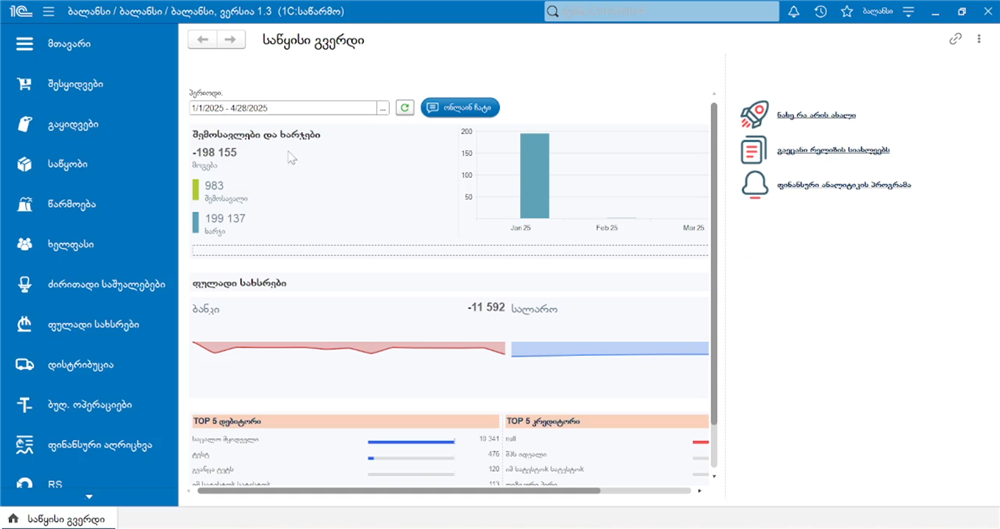
Balance is an enterprise accounting software created specifically for the Georgian tax environment and covers the full property tax cycle.
Core Functionality
Automatic calculation. Based on fully completed fixed asset data, Balance automatically calculates the average annual residual value, applies revaluation coefficients, and determines the final tax amount.
Declaration generation. The software generates the property tax declaration form, which can be uploaded to the Revenue Service's electronic portal.
Exemption management. The system allows specifying the type of tax exemption - under Part 1 of Article 206 of the Tax Code, Part 13 of Article 23, based on an international treaty, or an exemption established by other legislation.
Rate configuration. The software allows flexible rate setting - the standard 1% or 0.6% for leasing companies.
Reporting. Fixed asset reports, residual value tables, and depreciation schedules are available in a few steps, significantly reducing the time spent on manual preparation.
Recommended Workflow
Correct calculation and timely filing of property tax requires accurate fixed asset accounting, proper application of revaluation coefficients and exemptions, as well as correct specification of rates by territorial unit. The use of automated accounting systems, specifically Balance software, makes it possible to significantly simplify this process, reduce the risk of errors, and ensure that the declaration is submitted within the deadline.


 მენეჯერისთვის
 ბუღალტრისთვის
 აუთსორსერისთვის
 ავეჯი და საყოფაცხოვრებო პროდუქცია
 მშენებლობა
 სამშენებლო მასალები
 კვების პროდუქტები
 მეღვინეობა
 ტექსტილი და აქსესუარები
 ტექნიკა და დანადგარები
 ავტოსერვისი
 დისტრიბუცია
 Inventory
 Mardi
Mardi
-01.png) Echo
Echo
 დამატებითი ფუნქციონალები
 შესაძლებლობები
 განახლებები
 ხშირად დასმული კითხვები
 სასწავლო მასალები
